



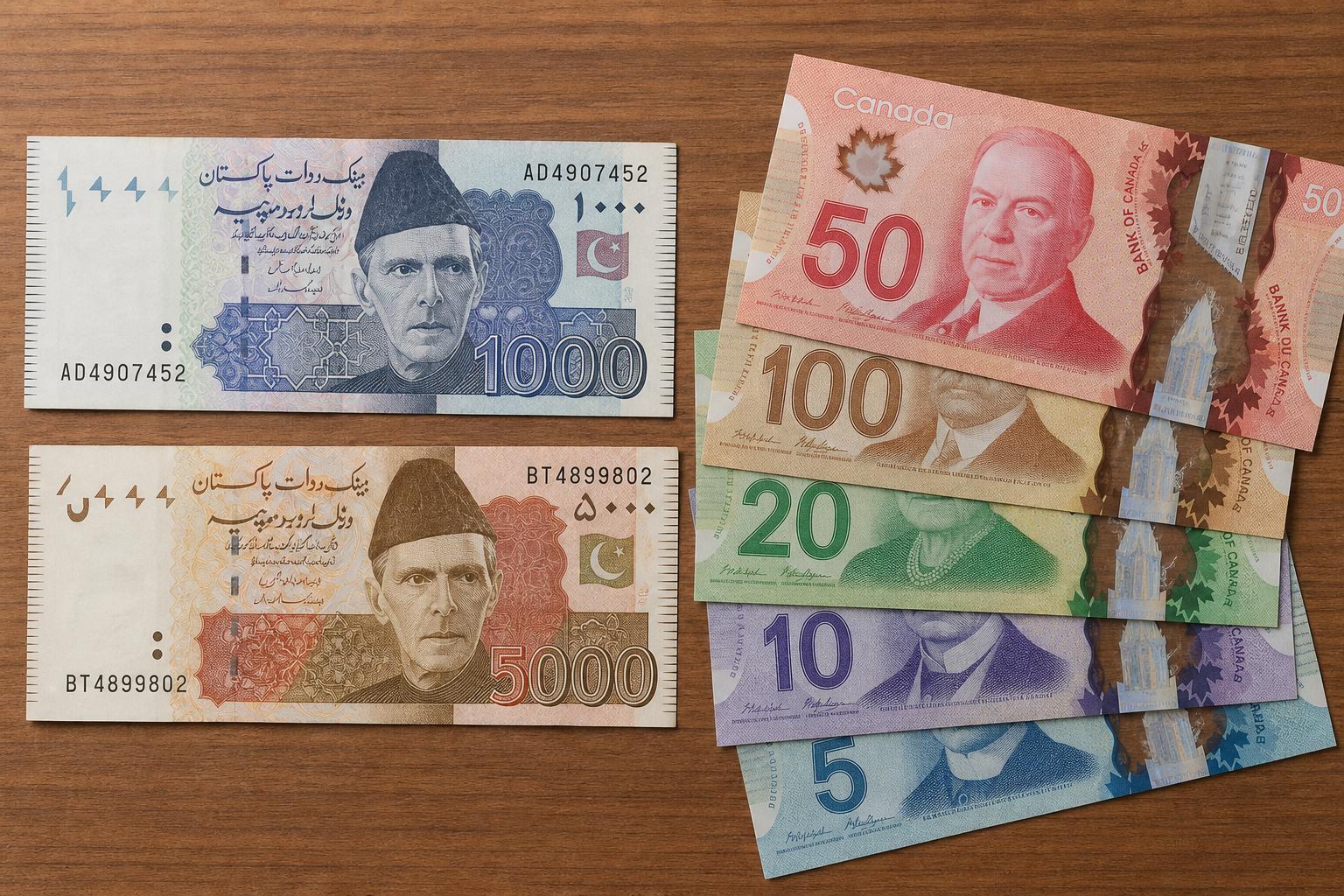






PKR to CAD: The Complete Canadian Guide to Converting Pakistani Rupees into Canadian Dollars
If you’ve ever tried to move money from Pakistan to Canada, you already know the stakes. Tuition deadlines. Rent deposits. Family support. Business invoices. One swing in the PKR to CAD exchange rate can mean the difference between a smooth transfer and a budget headache. This guide walks you through every practical step—from understanding how rates really work to choosing the cheapest channel for your situation—so you can convert Pakistani rupees to Canadian dollars with confidence.
You’ll learn how providers price currency, which fees quietly eat your money, how to time a transfer, what Canadian regulations mean for you, and how to avoid common pitfalls like frozen transfers or missing SWIFT details. We’ll keep the language simple, the advice concrete, and the examples realistic for life in Canada.
PKR to CAD 101: What “the rate” really means
Let’s strip away the mystery. At the core, converting Pakistani rupees to Canadian dollars is multiplication or division with a moving number: the exchange rate. That moving number is set by the market—banks trade currencies with each other all day long at wholesale prices known as the interbank rate (often called the mid-market rate in consumer apps).
Direct and indirect quotes: Which way are you looking?
Providers will show one of two conventions:
- PKR per 1 CAD (for example, PKR 200 = CAD 1). In this case, CAD = PKR ÷ rate.
- CAD per 1 PKR (for example, CAD 0.005 = PKR 1). In this case, CAD = PKR × rate.
Same math, different lens. What matters is consistency: if you’re comparing providers, make sure you’re comparing the same style of rate. If a bank shows PKR per CAD and an app shows CAD per PKR, pick one format and convert before you decide who is cheaper.
Mid-market rate vs. the rate you actually get
Apps like XE and Google typically display the mid-market rate—the midpoint between wholesale buy and sell prices. Consumers rarely get that exact rate. Instead, you get a customer rate, which is the mid-market rate plus or minus a markup. Markups are how providers earn money on exchange, along with explicit fees. Some providers are transparent and list both the fee and the markup; others hide the markup inside the rate, then advertise “no fees.”
The total cost formula you should actually use
When converting PKR to CAD, add everything together. The simple formula is:
- Final CAD received = (PKR amount × your rate in CAD/PKR) − fees
Or, if you see PKR per CAD:
- Final CAD received = (PKR amount ÷ your rate in PKR/CAD) − fees
Fees may include a fixed transfer fee, a percentage fee, intermediary bank charges, receiving bank fees in Canada, and conversion markups baked into the rate. It’s the final CAD figure that matters—not the marketing line.
Types of rates you’ll encounter
Not all “PKR to CAD” quotes are built for the same thing:
- Interbank/mid-market: the baseline, wholesale rate. Great for benchmarking. You won’t usually transact at this rate.
- Wire transfer rate: the customer rate your bank or money service offers you on a SWIFT transfer. Typically includes a markup.
- Cash exchange rate: what you’ll get at a currency exchange counter. Often worse due to handling and risk.
- Card network rate: what Visa or Mastercard uses for card transactions or ATM withdrawals. Your bank usually adds a foreign transaction fee on top.
- Open market (Pakistan) rate: the retail rate available in local exchange shops in Pakistan. Not the same as bank rates.
Rates also behave differently on weekends. Markets close, but consumers keep transacting. Providers either pause at Friday’s close or widen their markups to cover risk until markets reopen.
What drives the PKR/CAD exchange rate
Exchange rates aren’t random. They reflect a tug-of-war between two economies, two central banks, and global capital flows. You don’t have to be an economist to benefit from knowing the basics—just enough to spot when rates may be unusually favourable or risky.
Pakistan-side drivers (PKR)
Broadly, PKR tends to react to:
- Inflation and interest rates set by the State Bank of Pakistan (SBP). High inflation can pressure a currency, while high interest rates can attract capital—until economic growth slows.
- Current account balance and foreign exchange reserves. If Pakistan imports more than it exports and struggles to attract capital, reserves can fall and PKR can weaken.
- Remittance inflows. Overseas Pakistanis sending money home support FX reserves and can stabilize the rupee in certain periods.
- Policy changes and external financing. IMF programs, fiscal reforms, and privatization efforts can influence investor confidence and, by extension, PKR.
- Political stability and energy import costs. Currency markets dislike uncertainty; oil and gas prices matter for an importer.
Canada-side drivers (CAD)
On the Canadian side, the loonie moves with:
- Bank of Canada interest rate decisions. Higher policy rates often strengthen CAD by attracting yield-seeking capital.
- Commodity prices, especially oil. Canada is a major energy exporter; strong oil prices can buoy CAD.
- Inflation, GDP growth, and employment trends. Healthy data often supports a stronger currency, all else equal.
- Global risk sentiment. When markets are calm and risk-on, CAD may benefit as a commodity-linked, mid-sized currency.
Global cross-currents
Both currencies also dance around the U.S. dollar. When USD surges, many emerging market currencies—including PKR—tend to weaken. CAD may also soften against a strong USD, though less dramatically. Major geopolitical events, shifts in U.S. interest rates, and global supply chain news can ripple into the PKR to CAD rate quickly.
All the ways to convert PKR to CAD (and how to pick one)
Your best option depends on where the money starts (Pakistan or Canada), how fast you need it, whether it’s cash or bank-to-bank, and how much you’re moving. Below are the main channels Canadians and Pakistanis use to go from Pakistani rupees to Canadian dollars.
1) Bank wire transfer from Pakistan to Canada (SWIFT)
For large, documented transfers (tuition, settlement funds, business payments), a bank-to-bank SWIFT wire is still common. You can send in PKR and convert in Canada, or convert to CAD in Pakistan and send CAD. The right choice depends on rates and fees on each side.
How it works:
- Visit your Pakistani bank (e.g., HBL, UBL, MCB, Meezan, etc.) or use their online platform if available for international transfers.
- Provide your Canadian bank’s SWIFT/BIC code, your account number, and full beneficiary details exactly as on file. Canadian banks like RBC, TD, Scotiabank, BMO, and CIBC all provide incoming wire instructions on their websites or by request.
- Choose the currency of transfer. If you send PKR, the conversion may happen en route or on receipt in Canada. If you send CAD, the conversion happens in Pakistan at the PKR to CAD rate your Pakistani bank offers.
- Expect fees: an outgoing wire fee in Pakistan, potential intermediary bank fees, and a receiving fee in Canada. The exchange rate markup will be embedded if you convert on either side.
Pros: trusted, traceable, suitable for large sums with clear documentation. Cons: slower than online services (1–5 business days), higher total cost due to spreads and correspondent bank fees.
2) Online money transfer services
Specialized providers can be cheaper and faster than banks for retail-sized transfers. Many services let you fund converts from PKR to CAD through local Pakistani payment rails or a bank debit and deliver to a Canadian bank account, often within hours to 1–2 days.
What to compare:
- Do they quote the mid-market rate and a transparent fee, or just a “customer rate” with no fee? Transparent providers usually win on cost clarity.
- Can they deliver directly to Canadian bank accounts? Some route via local networks or partners for speed.
- Are they registered as a Money Services Business (MSB) with FINTRAC in Canada if they operate here? Registration signals regulatory oversight.
Pros: competitive PKR to CAD exchange rates, upfront pricing, faster delivery. Cons: transfer limits may apply; identity verification can take time; availability in Pakistan varies by provider and local regulatory permissions.
3) Currency exchange bureaus in Canada (for cash)
Arrived in Toronto or Vancouver with PKR cash? Converting cash PKR to CAD in Canada is possible but not universally available. Many Canadian exchange counters focus on major currencies (USD, EUR, GBP). Some larger bureaus in the Greater Toronto Area or Calgary may accept PKR, but the rate can be poor due to low demand and handling risk.
If you must convert cash:
- Call ahead to confirm they buy PKR and ask for a quote for your amount.
- Compare at least two counters. Airport kiosks are convenient but usually offer worse rates than city locations.
- Bring ID. Larger cash exchanges will ask for identification, especially near reporting thresholds.
Note: Carrying large sums of cash across borders triggers reporting requirements (more on that below). Cash also invites loss or theft risk. If you can, convert via bank accounts instead.
4) Using a Pakistani debit card in Canada
If your Pakistani bank card is on Visa or Mastercard, you can withdraw CAD at ATMs in Canada via global networks like Plus or Cirrus. The network sets a base rate; your Pakistani bank likely adds a foreign transaction fee (often 2–3%) plus an ATM withdrawal fee. The Canadian ATM may also charge a fee, especially at private machines.
Pros: quick access to CAD cash without prior arrangements. Cons: layered fees add up fast; daily withdrawal limits; not ideal for large sums or ongoing needs.
5) Peer-to-peer and informal channels (serious caution)
In some communities, people use informal networks—sometimes called hawala or hundi—to move value between Pakistan and Canada. While some transfers may arrive quickly at seemingly good PKR to CAD rates, these channels are unregulated in Canada if the operator is not registered as an MSB, and can expose you to legal, fraud, and AML risks. If a deal sounds too good, it probably is. Use regulated banks or FINTRAC-registered services.
6) Paying Canadian tuition and rent directly from Pakistan
Canadian universities and colleges often partner with payment platforms that accept local currency and convert to CAD on your behalf. You initiate from Pakistan, pay in PKR, and the school receives CAD. These platforms can offer competitive PKR to CAD exchange rates and integrated tracking. Always initiate from the school’s official payment portal or a vetted partner link; scammers love to impersonate tuition processors.
How much will it really cost? A side-by-side view
Let’s compare headline differences using a hypothetical PKR 2,000,000 transfer to a Canadian bank account. Assume market mid-rate is CAD 1 = PKR 220 (this is an example only—check live rates before you act). We’ll exaggerate less obvious costs so you can see how the pieces work. The totals below are illustrative.
| Channel | Quoted Rate or Markup | Explicit Fees | Other Costs | Estimated CAD Received |
|---|---|---|---|---|
| Major bank wire (convert in Pakistan) | 2.5% below mid-market | PKR 5,000 outgoing; CAD $15 incoming | Intermediary bank fee ~ CAD $20 | ~ CAD 8,670 |
| Online transfer service | 0.6% below mid-market | Fixed fee CAD $5 | None | ~ CAD 9,010 |
| Cash exchange counter in Canada | 3.5% below mid-market | None | Travel/risk costs | ~ CAD 8,530 |
These are not quotes—just a reality check on how quickly small percentages change outcomes. A tighter spread can save hundreds of dollars on a single transfer at this size.
Step-by-step scenarios for Canadians and Pakistanis
Scenario 1: You’re a new student in Toronto with funds in PKR
You’ve been accepted to a university in Toronto. You need to pay tuition, buy a SIM, and put down a rental deposit in CAD. Your savings are in PKR in a bank account in Pakistan. How do you convert PKR to CAD efficiently?
Practical route:
- Check whether your school has an official portal that accepts payment in PKR for tuition. If yes, compare the total cost with a direct PKR to CAD transfer to your Canadian account. Sometimes, the tuition portal offers excellent rates due to its volume.
- For living expenses, open a Canadian bank account as soon as you arrive. Many banks offer international student packages with no-fee accounts for the first year. You’ll need your passport, study permit, and school documents.
- Use a regulated online money transfer service to convert a portion of your PKR into CAD and deliver to your new Canadian account. Compare at least two providers for your specific amount and date; a 0.5–1.0% spread difference adds up over a semester.
- Avoid carrying large amounts of PKR cash to Canada. If you must, declare at the border if your total cash and monetary instruments are CAD 10,000 or more.
- Time your transfer on a weekday during market hours. Avoid weekend rates and big economic announcement windows if volatility bothers you.
If your bank in Pakistan offers student remittance products, ask about documentation. They may need an admission letter, tuition invoice, and your Canadian bank details. Processing times can stretch near term starts, so don’t leave transfers to the last minute.
Scenario 2: Monthly family support from Lahore to Calgary
You support a parent living in Calgary, sending the equivalent of CAD 1,000 each month from PKR savings or income. Your goals: low fees, predictable timing, and strong value.
Practical route:
- Pick two or three reputable online services that support PKR to CAD with transparent pricing. Do a trial run with a small transfer to compare speed, customer service, and the final CAD amount received.
- Set monthly reminders to check rates on the same weekday at the same time (market hours). If one provider consistently delivers a better final CAD, stick with them—but check competitors quarterly.
- Fund transfers using local rails in Pakistan when possible to reduce banking fees. Some providers allow bank debit or local payments that are cheaper than SWIFT wires.
- Have the recipient in Calgary keep a dedicated Canadian chequing account for receiving these transfers, with e-Statements turned on. Clean documentation helps if banks ever question the activity.
Watch for loyalty pricing. Some providers lower fees after a few months or at certain volume tiers. Also, try to avoid sending on Friday evenings (Pakistan time) or over Canadian holidays, as settlement may slip to Monday or later.
Scenario 3: You’re moving to Canada and want to bring savings efficiently
You’ve got a nest egg in PKR and plan to settle in Vancouver. You need to move a significant amount, but you’re worried about timing risk and compliance checks.
Practical route:
- Open a Canadian bank account as soon as you’re eligible, even before arrival if your bank supports international onboarding for newcomers. Some Canadian banks allow remote pre-opening for permanent residents or via newcomer programs.
- Move your funds in staged transfers rather than one giant wire. This reduces single-transaction scrutiny, may get you better blended rates over time, and keeps cash flow flexible. Keep each transfer fully documented (bank statements, proof of source of funds, sale agreements if applicable).
- Compare converting to CAD in Pakistan versus sending PKR and converting in Canada. Ask both your Pakistani and Canadian bank for an all-in quote for the same day and amount. Include possible intermediary bank fees if you use SWIFT.
- If you have a defined CAD budget (e.g., for a home deposit), consider partial hedging: convert a portion now to lock in certainty and leave some to market timing. Businesses use forwards; individuals can use staged conversions to mimic hedging.
Be ready for due diligence questions from the Canadian bank on arrival of larger funds. This is standard under anti-money laundering rules. Advance organization makes the process smoother: have PDFs of pay slips, tax returns, and sale deeds ready.
Scenario 4: A Canadian small business paying a supplier invoiced in PKR
While many international suppliers invoice in USD, some Pakistani vendors quote in PKR. A Canadian company can still settle in CAD via the vendor’s bank instructions, but someone has to do the PKR to CAD conversion or vice versa. Who should convert?
Practical route:
- Ask the supplier for both PKR and CAD quotes, valid for the same window. Compare your bank’s CAD to PKR rate (if paying PKR directly) against a Canadian FX provider’s CAD to PKR offering. Pick the cheaper path.
- Consider using a Canadian FX specialist that offers business accounts, forward contracts, and same-day wires. A forward lets you lock a CAD/PKR rate for a future invoice, reducing budget risk.
- Confirm the supplier’s Pakistani IBAN and SWIFT details carefully. Pakistan uses ISO-compliant IBANs starting with “PK,” followed by bank and branch identifiers. One wrong digit leads to delays.
- Keep a clean paper trail (purchase order, contract, commercial invoice, proof of delivery milestones). It’s not just compliance—it’s leverage if a transfer gets stuck mid-route.
Ask your accountant about accounting for FX differences. Even small swings between invoice date and payment date can produce gains or losses on your books.
How to get a fair PKR to CAD exchange rate every time
1) Always benchmark against the mid-market rate
Before you commit, look up the mid-market rate for PKR to CAD on a reputable source. It takes 10 seconds and frames every quote you see. If a provider’s customer rate is 1.8% away from mid-market and another is 0.6% away—with similar fees—the 0.6% option is almost certainly better.
2) Add up the full cost, not just the headline
Providers can structure fees in endlessly creative ways. Create a quick worksheet for any larger transfer:
- PKR amount
- Quoted PKR to CAD rate (difference vs. mid-market)
- Explicit fee
- Receiving bank fee (ask your Canadian bank; many publish standard fees)
- Estimated intermediary/correspondent bank fees (for SWIFT wires)
- Final CAD delivered
Run the math for two or three options before you click send. For recurring transfers, revisiting this checklist quarterly is enough.
3) Avoid weekend and off-hours conversions
FX markets close on weekends. Many consumer providers widen spreads to protect against Monday gaps. If timing is flexible, convert PKR to CAD during overlapping business hours—ideally early to mid-week. Also avoid moments around major central bank announcements if you don’t like surprises.
4) Split large transfers into tranches
Moving a large sum? Converting in two or three tranches smooths timing risk. If the rate improves, you benefit on the later tranches. If it worsens, at least you locked part of the funds earlier. This strategy doesn’t beat the market; it controls regret.
5) Negotiate if your volume is meaningful
For substantial or regular transfers, ask for better pricing. Banks and FX providers may reduce markups for loyal customers or higher tiers. It’s not impolite—it’s business.
Canadian rules and real-world compliance you should know
Canada is strict but straightforward. Know the rules, and you’ll have fewer surprises when converting PKR to CAD or receiving funds from Pakistan.
FINTRAC and MSB basics
In Canada, Money Services Businesses (MSBs) and financial institutions must comply with the Proceeds of Crime (Money Laundering) and Terrorist Financing Act. Key points relevant to you:
- Registration: Any business dealing in foreign exchange, remittances, or money transfers in Canada must register with FINTRAC. Use registered providers.
- Reporting thresholds: Regulated entities must report large electronic funds transfers of CAD 10,000 or more in a single transaction or multiple linked transactions within 24 hours. Suspicious transactions must be reported regardless of amount.
- Identity verification and records: Expect to provide valid ID, and sometimes proof of source of funds for larger or unusual transfers.
For consumers, these rules operate in the background. But they explain why a bank may ask for documents or hold a transfer until they complete checks. It’s normal, not personal.
Crossing the Canadian border with cash
Carrying cash or monetary instruments worth CAD 10,000 or more into or out of Canada? You must declare it to the Canada Border Services Agency (CBSA). Declaring is not a tax; it’s an anti-money-laundering requirement. Failure to declare can lead to seizure and penalties. If you’re moving to Canada, consider safer, documented channels instead of carrying large PKR cash.
CRA and tax considerations
Currency conversion itself isn’t taxed in Canada. But a few rules matter:
- Personal-use foreign currency: Small gains or losses from converting funds for day-to-day use are generally not taxable if they’re incidental. Keep records if amounts are large or tied to investments.
- Investments: If you hold foreign currency or assets for investment, foreign exchange gains and losses may be taxable. Track amounts in CAD using the Bank of Canada exchange rates or reasonable spot rates on transaction dates for your records.
- Gifts and remittances: Sending money to family is not tax-deductible. Receiving a gift is generally not taxable in Canada. However, if you hold foreign property (e.g., a bank account in Pakistan) and the total cost amount of your foreign property exceeds certain thresholds, additional reporting may apply. Speak with a Canadian tax professional about your situation.
When in doubt, document your transfers and keep year-by-year summaries in CAD. Good records are your best friend.
Bank policies: holds, limits, and source-of-funds checks
Canadian banks may place holds on incoming wires—especially if the activity is new or the amounts are large. They may ask for documents such as pay slips, tax returns, sale contracts, or letters explaining the source of funds. Provide clear PDFs promptly. If you plan to receive a large PKR to CAD equivalent, call your branch in advance so they’re ready.
Common hurdles (and how to dodge them)
Getting the receiving details wrong
Typos cause delays. Double-check:
- Canadian bank name and address.
- SWIFT/BIC code for the specific bank (not the branch transit number).
- Your account number and transit/branch info if required by the sending bank.
- Your full legal name as it appears on the Canadian account. Avoid nicknames or mismatched spellings.
In Pakistan, always use the exact IBAN format when receiving returns or refunds. Pakistan uses IBANs starting with “PK,” followed by bank and branch codes and the account number. One character off can bounce the wire.
Weekend and holiday mismatches
Canada and Pakistan have different holiday calendars and time zones. A transfer sent Friday afternoon in Pakistan may not hit a Canadian account until Monday or Tuesday if intermediaries are closed. If speed matters, initiate transfers early in the week and check holiday calendars in both countries.
Unexpected intermediary bank fees on SWIFT wires
Even if your bank discloses its fees, intermediaries can skim CAD $10–$40 along the route. Ask your bank whether they can send “OUR” (you pay all fees) or “SHA” (fees shared) and what that practically means when converting PKR to CAD. For predictable totals, consumer-focused online services often beat SWIFT wires.
Transfers flagged for compliance
Patterns that differ from your usual activity, brand new large transfers, or inconsistent documentation can trigger reviews. Preempt this by:
- Notifying your Canadian bank before a large incoming wire.
- Keeping consistent sender/receiver names and purposes.
- Providing invoices, tuition letters, or proof-of-funds documents quickly when asked.
Too-good-to-be-true “open market” quotes
If a quote beats everyone by a mile, ask how the provider is regulated and what the exact delivery method is. In Canada, using unregistered MSBs or informal operators can put you at risk. Cheap is great. Compliant and cheap is what you want.
When is it better to convert in Pakistan vs. in Canada?
This comes up a lot. The answer is: run the numbers both ways for your exact amount and day. Consider:
- If Pakistan-side banks offer tight PKR to CAD spreads with low wire fees, converting in Pakistan and sending CAD can make sense.
- If Canadian banks or online services give you a better CAD rate (from incoming PKR) and lower fees, sending PKR and converting in Canada may be cheaper.
- SWIFT intermediary fees may erase a small rate advantage. Predictability matters as much as the headline rate.
Do a live quote both ways within the same hour. Pick the higher final CAD outcome after all fees.
A simple workflow for smart PKR to CAD conversions
- Define the purpose and urgency (tuition deadline vs. flexible savings transfer).
- Check the live mid-market PKR to CAD rate to create a baseline.
- Gather two or three real quotes for your amount: bank wire, online service A, online service B.
- Calculate final CAD after all fees. Don’t forget potential receiving/intermediary fees for wires.
- Pick the provider with the best mix of speed, documentation, and total value.
- Send early in the week and keep records (confirmations, exchange rate, time, purpose).
- For repeat transfers, set a quarterly reminder to re-check providers.
How to read a PKR to CAD quote like a pro
When a provider shows you a rate, parse it with three quick questions:
- How far is their customer rate from the mid-market rate right now? If they don’t show it, check elsewhere.
- What explicit fees apply at my size? Flat fees punish small amounts more than large ones.
- What’s the guaranteed CAD amount the recipient will see? If they can’t tell you, that’s a red flag.
Some services let you lock a quote for a few minutes. If you pause and refresh, the rate may shift slightly. That’s normal in active markets.
Timing tips without turning into a trader
You don’t need to predict markets to be smart about timing:
- Avoid converting on weekends and around major Canada or Pakistan holidays.
- If the rate is on a multi-week upswing in your favour, consider accelerating part of your transfer.
- Break large sums into tranches over 1–3 weeks to average out short-term volatility.
- Set simple rate alerts on reliable apps to nudge you when PKR to CAD improves past your target.
Remember: certainty has value. If missing a tuition deadline costs you late fees or dropped courses, chasing a tiny rate improvement is not worth it.
Practical documentation checklist
Before you convert PKR to CAD or initiate a transfer, gather:
- Government-issued ID (passport, Canadian PR card, or driver’s licence for Canadian-side verification).
- Bank account details (Canadian account and Pakistani account, including SWIFT/IBAN if needed).
- Purpose of payment (tuition invoice, lease agreement, support letter, business invoice).
- Proof of source of funds for larger transfers (employment letter, pay slips, tax returns, sale agreements).
- Recipient’s full legal name and address as per the bank account.
Good paperwork cuts down on questions and delays. Keep digital copies in a secure folder you can access on both sides of the ocean.
Fees and markups: what’s typical in Canada?
While every provider sets its own pricing, here’s what Canadians often encounter:
- Bank FX markups: commonly 1.5%–3.5% from mid-market for retail clients.
- Online money transfer services: spreads around 0.3%–1.0% plus a small transparent fee.
- Outgoing international wire fee (Canada): often CAD $10–$30.
- Incoming international wire fee (Canada): typically CAD $0–$15 for many banks.
- Intermediary/correspondent fees: CAD $10–$40 on some SWIFT routes (unpredictable).
- Card foreign transaction fees: often ~2.5% on Canadian credit/debit cards when used abroad; for Pakistani cards used in Canada, check your bank’s fee schedule.
Your goal is to minimize both the spread and the fixed fees for your specific amount and timing. For small to mid-sized transfers, consumer-focused online services often beat bank wires. For very large transfers, negotiate with your bank or a corporate FX desk.
Choosing a provider: a quick scorecard
| Factor | Why it matters | What “good” looks like |
|---|---|---|
| Exchange rate | Determines most of your total cost | Within ~0.2%–0.8% of mid-market for retail transfers |
| Fees | Fixed fees hurt small transfers | Clear, low, and upfront; no hidden receiving costs |
| Speed | Matters for tuition, rent, emergencies | Same-day or next-day delivery to Canadian accounts |
| Regulatory status | Protects you from compliance risks | FINTRAC-registered if operating in Canada |
| Transfer limits | Prevents failed attempts | Limits aligned with your needs; ability to increase with verification |
| Customer support | Crucial if a transfer is delayed | Responsive support with clear escalation paths |
Special notes for students, newcomers, and families
International students from Pakistan
Canada’s Student Direct Stream (SDS) requires proof of funds and often a Guaranteed Investment Certificate (GIC) from a participating Canadian bank. The required amounts and participating banks can change, so confirm details on official Government of Canada channels. When funding your GIC, ask the bank or the program’s payment partner for the best way to move PKR to CAD at a fair rate.
For tuition, always start from your school’s official payment page. Avoid links from third-party emails. If you’re unsure, call the bursar’s office and verify the proper process.
Newcomers and permanent residents
When you land, open a Canadian chequing account early. Many newcomer packages include fee waivers, safe deposit discounts, and referral bonuses. If you plan to bring funds in stages from PKR, ask your branch for their incoming wire details and any receiving fees. Also ask what evidence they require for large incoming amounts; each bank has its own checklist.
Families supporting relatives across borders
Set up predictable routines. Send on the same date each month, maintain clear notes on transfer purposes, and keep confirmation PDFs for a year. If your relative changes banks or addresses in Canada, update the beneficiary details immediately to prevent mismatches.
Safety first: scams and mistakes to avoid
- Imposter tuition portals: always navigate from your school’s official site. Scammers mimic university logos well.
- “Guaranteed best rate” from unregistered operators: verify registration with FINTRAC if they operate in Canada. If they won’t tell you their regulatory status, walk away.
- Phishing texts about “failed transfers”: never click links in unsolicited messages. Log in directly to your provider’s app or website.
- Sharing one-time codes: no legitimate provider asks for your OTP outside of the normal login or transaction flow.
- Rushed weekend deals: pressure tactics are a red flag. Real providers let you compare calmly.
Technical corner: bank details for Canada and Pakistan
For Canada-bound wires, you typically need:
- Beneficiary name and address (exact legal name on the account).
- Canadian bank’s name and address.
- SWIFT/BIC code of the Canadian bank.
- Account number and transit/branch number (if requested).
- Sometimes an institution number or routing details specific to the bank.
For Pakistan-side information (e.g., refunds or return wires), ensure the Pakistani IBAN is correct and active. Pakistan uses standardized IBAN formats; your bank can confirm yours. A single digit error is the most common cause of delays and returns.
Tools that make PKR to CAD conversion easier
- Rate trackers and alerts: set an alert when PKR to CAD crosses your target. It saves you from checking every day.
- Provider calculators: use them to get guaranteed quotes and final CAD amounts before committing.
- Simple spreadsheet: track date, amount in PKR, mid-market rate, provider rate, fees, and CAD received. After three months, you’ll know who really gives you value.
- Bank-of-record statements: download monthly statements from both sides (Pakistan and Canada) to keep your documentation tidy.
Glossary: no-nonsense definitions
- Mid-market rate (interbank rate): the midpoint between wholesale buy and sell prices in the FX market. Benchmark only.
- Spread/markup: the difference between the mid-market rate and the rate you actually get. Provider’s built-in margin.
- SWIFT/BIC: global messaging system and identifier used for international bank transfers.
- IBAN: International Bank Account Number. Pakistan uses IBAN; Canada generally does not, relying on transit and account numbers.
- Correspondent bank: an intermediary bank that helps move money between two banks that don’t have a direct relationship.
- Settlement: the moment the funds actually arrive in the recipient account.
A quick example: calculating the real cost
Say you’re converting PKR 1,000,000 to CAD. Mid-market at the moment is CAD 1 = PKR 220. Two providers quote:
- Provider A: Rate = CAD per PKR of 0.00448 (2% below mid), fee CAD $6.
- Provider B: Rate = CAD per PKR of 0.004545 (0.5% below mid), fee CAD $20.
Math:
- Provider A: 1,000,000 × 0.00448 = CAD $4,480; minus $6 = CAD $4,474.
- Provider B: 1,000,000 × 0.004545 = CAD $4,545; minus $20 = CAD $4,525.
Even with a higher fee, the tighter exchange rate wins by CAD $51 on this transfer. Scale that to multiple months, and the savings are meaningful.
What about converting CAD to PKR?
Many readers will also need to go the other way: sending money from Canada to Pakistan, or paying expenses in PKR from a Canadian account. The logic is the same—check mid-market, compare total costs, and use regulated providers. Some Canadian banks offer competitive CAD to PKR wires if you negotiate or hold a premium account. For personal remittances, online transfer services often win on both rate and speed. If your life involves both directions, track both “PKR to CAD” and “CAD to PKR” pairs over time; sometimes one side is consistently cheaper, and you can plan accordingly.
Regional notes within Canada
Where you live in Canada can shape your options:
- Greater Toronto Area: the largest selection of currency exchange bureaus and community-oriented MSBs; good for competitive quotes—verify registration.
- Vancouver and Calgary: strong banking presence and access to international services; many newcomers rely on online platforms first.
- Montreal and Ottawa: similar access through national banks and global providers; French-language support may be available in Quebec.
- Smaller cities: fewer in-person options; online money transfer services level the playing field.
No matter the city, online providers have narrowed regional gaps in pricing and speed. Just ensure the provider supports your specific PKR to CAD corridor.
Final takeaways
Converting PKR to CAD doesn’t have to be stressful. Focus on three things: the mid-market benchmark, the all-in cost, and the reliability of the provider. Use weekdays, avoid rushing, and keep clean records. For recurring transfers, build a simple routine and re-check pricing a few times a year. For large moves, stage your conversions and inform your bank in advance. Do that, and you’ll keep more of your money in Canadian dollars—where you need it.
FAQ: PKR to CAD, answered
What’s the cheapest way to convert PKR to CAD?
Often a regulated online money transfer service with a transparent, near–mid-market rate and a small fee. For very large transfers, a negotiated bank rate or business-grade FX provider can compete. Run a live comparison for your amount.
Is it better to convert in Pakistan or in Canada?
It depends on the day’s spreads and fees. Get a same-day all-in quote for both options (convert in Pakistan then send CAD, or send PKR and convert in Canada). Pick the higher final CAD amount after fees.
How long do PKR to CAD transfers take?
Online services: often same day to 2 business days. Bank SWIFT wires: 1–5 business days depending on correspondent banks and compliance checks. Weekends and holidays add delays.
Are there legal limits on how much I can send?
Canadian banks and MSBs set their own limits and must comply with FINTRAC reporting rules. Pakistan also has its own foreign exchange regulations. For large sums, expect documentation on source of funds. Check both your Pakistani bank’s rules and your Canadian bank’s policies before initiating.
Do I pay taxes on converting PKR to CAD?
No, currency conversion itself isn’t taxed in Canada. However, FX gains related to investments may be taxable. Gifts and family remittances are generally not taxable to the recipient. Keep records and consult a Canadian tax professional if your situation is complex.
Can I bring PKR cash to Canada and exchange it there?
Some Canadian exchange bureaus may buy PKR, but availability and rates vary widely. Carrying CAD 10,000 or more in cash or monetary instruments requires a CBSA declaration. In most cases, electronic transfers are safer and better value.
How do I avoid bad exchange rates?
Benchmark against the mid-market rate, compare at least two providers, avoid weekend conversions, and choose transparent pricing. For recurring transfers, track your results in a simple spreadsheet and switch providers if your final CAD lags consistently.
Why did my bank hold my incoming transfer?
Banks must perform anti-money laundering checks. Large, unusual, or first-time transfers can trigger holds while they verify details. Provide requested documents promptly, and notify your bank in advance of larger incoming amounts to reduce delays.
Is Interac e-Transfer an option for PKR to CAD?
Interac e-Transfer is for domestic Canadian transfers in CAD only. For PKR to CAD, use international money transfer services or bank wires.
What’s the difference between the mid-market rate and the customer rate?
The mid-market rate is the wholesale benchmark between banks. The customer rate is the actual rate you get, which includes the provider’s markup. Your job is to minimize that markup and any additional fees.
Can I lock a PKR to CAD rate for the future?
Most consumer services don’t offer true forwards. Businesses can use forward contracts with banks or FX specialists to lock rates for future payments. Individuals mimic hedging by splitting transfers over time.
What documents should I keep?
Keep transfer confirmations, rate quotes, purpose notes (tuition invoices, lease agreements), and proof of source of funds for larger sums. Store statements from both sides for at least a year, longer if tax-related.
Are open market rates in Pakistan reliable for comparison?
They’re useful as a local retail benchmark, but they are not necessarily the rate you’ll get through banks or Canadian providers. Always compare like with like—use mid-market as your universal anchor and evaluate the final CAD amount from each provider.
What if a provider promises “no fees”?
They may bake their charges into the PKR to CAD exchange rate. That’s fine if the final CAD amount is strong. Always compare the final number, not the slogan.