










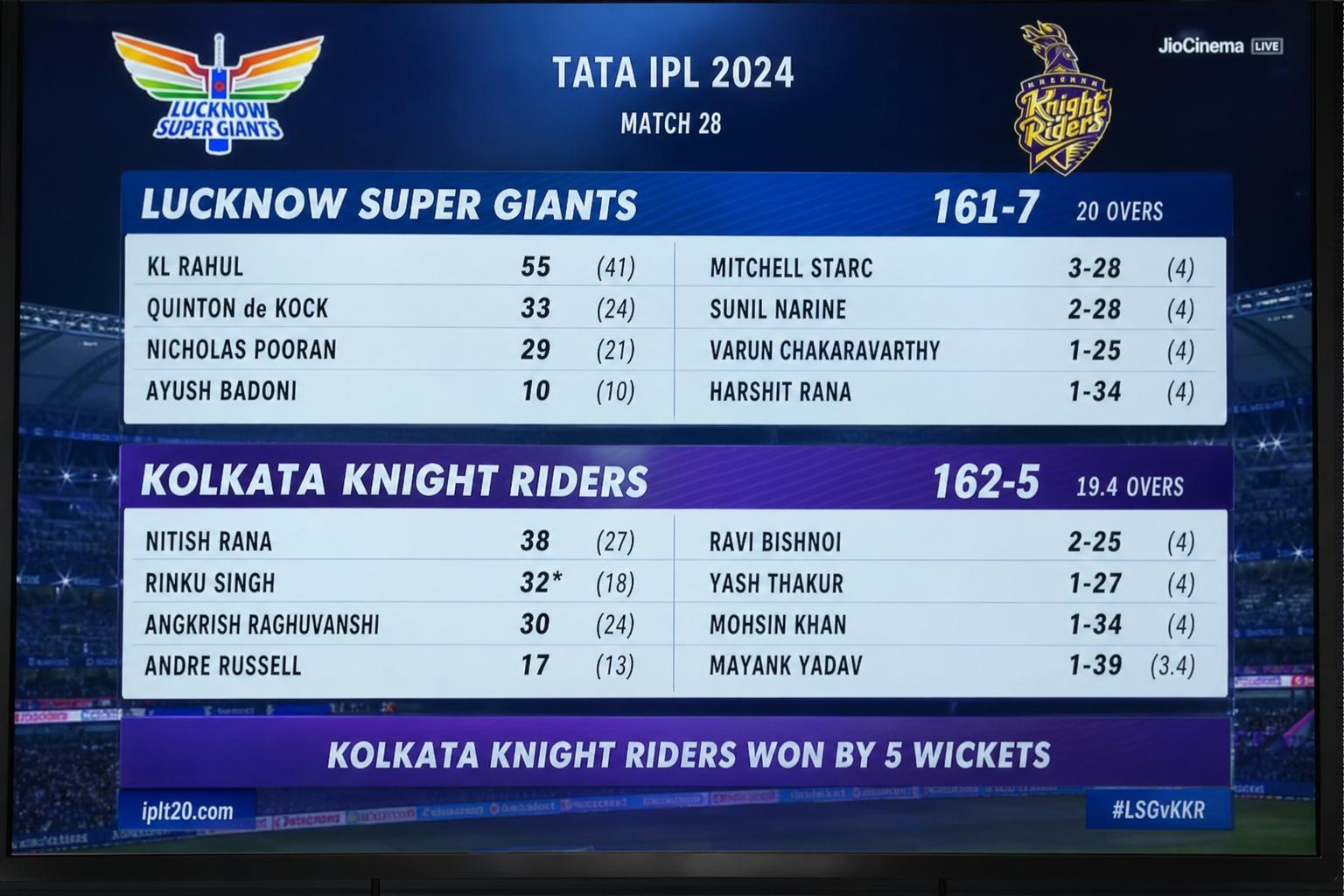
Lucknow Super Giants vs Kolkata Knight Riders Match Scorecard: Your Complete Guide to Finding, Reading, and Learning From It
When a Lucknow Super Giants vs Kolkata Knight Riders match heats up, the scorecard becomes more than a list of numbers—it’s the story of the game in miniature. Who accelerated in the death overs? Which spinner choked the middle? Where did the chase wobble? A proper read of the scorecard answers all of that, quickly and reliably. If you live in Canada and want the latest Lucknow Super Giants vs Kolkata Knight Riders match scorecard, or you simply want to understand every line on it like a pro, this guide walks you through the what, where, and how—without fluff.
Below, you’ll find the best places to get an official, real-time scorecard; a simple way to read batting and bowling lines; the meaning behind common abbreviations; historical context for this rivalry; and practical Canadian-focused tips on streaming, time zones, and responsible play. You’ll also learn how to use a scorecard to extract tactical insight: phase-by-phase pressure, matchups that routinely matter, and how venues like Eden Gardens and Lucknow’s Ekana Stadium imprint their character on the numbers.
Where to Find the Latest Lucknow Super Giants vs Kolkata Knight Riders Match Scorecard
The fastest path to a reliable scorecard is to stick with official or widely trusted outlets. These platforms update ball-by-ball and publish full match reports, wagon wheels, Manhattan graphs, and advanced breakdowns once the game is done. For Canadian fans, most of these are accessible on web or app with no regional lock for basic scores.
- IPL’s official site and app: iplt20.com and the IPL mobile app provide live scores, official playing XIs, Impact Player updates, and post-match PDFs or summaries.
- ESPNcricinfo: espncricinfo.com offers detailed Lucknow Super Giants vs Kolkata Knight Riders match scorecards, ball-by-ball text, advanced stats splits (powerplay, middle, death), and player career context.
- Cricbuzz: cricbuzz.com is quick on updates, with a clean layout for live commentary, partnerships, and phase-wise summaries.
- Google’s match panel: Search “LSG vs KKR score” or “Lucknow vs Kolkata score” and you’ll see a compact card on the results page. It’s lightweight and reliable for at-a-glance numbers.
- Broadcaster apps: If you have a legal streaming subscription in Canada, check the scoreboard tab inside the app. Rights shift season to season, but IPL coverage in North America has often been carried via Willow platforms and affiliated services. Always confirm current rights with your cable or streaming provider.
Tip for speed: Save the ESPNcricinfo and Cricbuzz match pages to your phone’s home screen. When you’re on the TTC in Toronto or the SkyTrain in Vancouver and network coverage flutters, a light webpage can still refresh faster than a heavy app.
The Anatomy of an IPL Scorecard (What Every Line Tells You)
Scorecards are standardized, but T20 cricket has evolved fast—especially since the Impact Player rule arrived. Let’s decode the whole page so you can read any Lucknow Super Giants vs Kolkata Knight Riders match scorecard with ease.
Core Sections You’ll Always See
- Match header: Teams, venue, date, toss result, match number (league stage or playoffs), and result.
- Innings summaries: Team totals (runs/wickets), overs faced, run rate, and extras (b, lb, w, nb, p).
- Batting table: For each batter—how they got out, runs, balls, 4s, 6s, strike rate.
- Bowling table: For each bowler—overs, maidens, runs, wickets, economy, wides/no-balls.
- Fall of wickets (FoW): The score at each dismissal, and the batter dismissed.
- Partnerships: Runs added by each pair, often with balls faced and contribution split.
- Impact Player and substitutes: Who was substituted in, and when.
- Umpires, Player of the Match, match awards, and occasionally a link to the full match report.
Batting Lines: What to Look For
On a Lucknow Super Giants vs Kolkata Knight Riders scorecard, batting lines reveal intent, matchups, and game flow. Focus on these indicators:
- Runs (R) and Balls (B): Context matters. A 45 off 25 in the powerplay can set up a chase decisively; a 30 off 30 in the middle can stall momentum if wickets in hand were healthy.
- Strike Rate (SR): Calculated as 100 × runs/balls. In the IPL, top-order SRs often push 135–160; late-overs finishers might exceed 180 in purple patches.
- Boundary Count (4s, 6s): Some innings thrive on hard running, others on clean hitting. A 36 (6×4) looks fine, but a 36 (6×1×6) shifts fielding pressure in a different way entirely.
- How Out: “c” for caught, “b” for bowled, “lbw” for leg before wicket, “run out,” “st” for stumped. Stumpings and bowled dismissals often hint that spin was turning or skidding.
Bowling Lines: Control vs Strike
In the IPL, numbers move quickly. A tidy over in the middle can turn a match. On the bowling side, read these first:
- Overs (O) and Economy (Econ): Economy tells you containment; keep an eye on whether the bowler was deployed in the powerplay, middle, or death—context shifts expectations.
- Wickets (W): Dismissals matter more than dot balls at the death, but in the powerplay, a wicket-maiden can swing win probabilities dramatically.
- Wides (w) and No-balls (nb): Discipline is worth runs—especially after the 2023 change that allowed wide/no-ball DRS reviews. Tight lines often win tense finishes.
Extras and What They Signal
Extras aren’t throwaway runs; they flag pressure or sloppiness. A haul of wides can mean an aggressive yorker plan missed its mark; leg-byes suggest scrappy strike rotation against sharp spin or pace. In tight Lucknow Super Giants vs Kolkata Knight Riders contests, extras have repeatedly kept the chasing side alive.
Impact Player: The Post-2023 Twist
Since IPL 2023, teams may name up to five substitutes and bring one on as the Impact Player, swapping with someone from the starting XI. Scorecards will mark the Impact Player and clarify who was replaced. It skews strategy—teams can front-load batting if they’re set to chase, then inject an extra bowler later. When you read the scorecard, check if a batter with just a few balls faced was subbed out, or if a fresh bowler appears mid-innings with a “(Impact)” tag.
Putting It All Together: A Clean Layout
Here’s a compact, generic scorecard layout. It’s not tied to any single match—use it as a map to decode the real thing.
| Team A Innings | |||||
|---|---|---|---|---|---|
| Total: 0/0 in 0.0 overs (RR 0.00); Extras 0 (b 0, lb 0, w 0, nb 0, p 0) | |||||
| Batter | Dismissal | R | B | 4s | 6s |
| Opener 1 | c X b Y | 0 | 0 | 0 | 0 |
| Opener 2 | not out | 0 | 0 | 0 | 0 |
| Fall of wickets: 0-1 (Name, 0.0 ov), 0-2 (…) | |||||
| Bowler | O | M | R | W | Econ |
| Bowler A | 0.0 | 0 | 0 | 0 | 0.00 |
On a full Lucknow Super Giants vs Kolkata Knight Riders match scorecard, you’ll see two such innings—plus Impact Player notes, awards, and partnership lists. Learn this skeleton once; the game’s narrative clicks into place every time.
Reading the LSG vs KKR Scorecard Like an Analyst
Two teams, one page of numbers—how do you extract real insight? Break the match into phases, check matchups, and adjust for the venue.
Phase-by-Phase: Powerplay, Middle, Death
Phase reading keeps you from overrating or underrating any one innings. Consider a typical innings arc:
- Powerplay (Overs 1–6): Look for wickets lost and run rate. A 50/1 is strong. A 30/3 is fragile, even if a late cameo saves the total. If you see a 36/0 but both openers faced 18+ balls each, the middle needs a spark.
- Middle Overs (7–15): Against KKR, mystery spin (Sunil Narine, Varun Chakravarthy) has regularly decided tempo. Against LSG, tall left-arm pace and hit-the-deck seamers often own this stretch. Read economy, boundaries conceded, and dot-ball count; a 2/18 in this window can outweigh a 1/12 powerplay spell.
- Death Overs (16–20): Check strike rate spikes—look for a finisher’s impact (Nicholas Pooran for LSG, Andre Russell or a promoted Narine for KKR). Note wides/no-balls: one over with two extras can flip a one-run game.
Scorecards often include “Phase Summary” or “Powerplay/Middle/Death” splits. If not, ball-by-ball commentary helps you reconstruct it. A 60-run final five overs is very different when preceded by 9 quiet overs versus a steady build with wickets in hand.
Key Matchups That Shape This Rivalry
Even without the live telecast, the scorecard hints at who won personal battles:
- LSG left-handers vs KKR spin: When LSG stack lefties (e.g., Nicholas Pooran, Krunal Pandya) and the scorecard shows tidy overs from Narine/Chakravarthy, KKR probably controlled the middle.
- KKR top order vs LSG new ball: If the powerplay FoW shows early wickets for an LSG left-arm seamer, that’s a classic Lucknow template—drag the game into the middle with spin/pace variations to squeeze.
- Finishers’ cameo length: Russell and Pooran cameo lengths matter. A 20 off 7 can be match-defining if it lands late with support from the other end; the partnership panel will reveal whether the blitz was isolated or sustained.
Venue Matters: Eden Gardens vs Ekana
Most Lucknow Super Giants vs Kolkata Knight Riders matches alternate between Kolkata’s Eden Gardens and Lucknow’s Bharat Ratna Shri Atal Bihari Vajpayee Ekana Cricket Stadium. Conditions change the scorecard’s personality:
- Eden Gardens, Kolkata: Historically batting-friendly with truer bounce, though day-to-day strips vary. Dew can make chasing easier—look at economy rates for spinners in the second innings and the wides/shortness from pacers forced to search for grip.
- Ekana Stadium, Lucknow: Several seasons showed slower tracks that demand touch and rotation. If strike rates stall in the middle and wickets fall to cutters or stumpings, the surface likely held. Totals under 160 can be highly competitive here.
When the result reads “won by 1 run” or “won by 2 wickets,” scan the extras and the 15–19 over economy figures. Those lines usually tell you exactly where the game tipped.
Rivalry Snapshots You Can Verify on the Scorecard
A rivalry is built on moments the scorecard immortalizes. In this fixture, a few stand out:
- Quinton de Kock’s epic in 2022: An unbeaten 140-plus with KL Rahul for a record opening stand gave LSG a platform that proved just enough, even after a late KKR onslaught. The batting table from that night reads like a time capsule of sustained dominance at the top.
- Evin Lewis’s stunning catch in a last-over thriller: A near-heist by KKR swung on a single, sensational fielding moment. The scorecard shows a wicket at the death; the highlights reveal the acrobatics behind it.
- One-run drama at Eden Gardens in 2023: Another chase, another photo-finish. The final over extras, the dot-ball count, and a lone unbeaten half-century sketch the tension without any video required.
Look for patterns—not just outcomes. In multiple tight finishes between these two, the best innings often arrived too late to repair damage from the middle overs. When you see a heroic 60-plus not out at a 190+ strike rate, but the team still falls short, the partnerships and FoW lines will usually show why.
How to Read a Scorecard When You Don’t Have the Broadcast
Maybe you’re on a lunch break in Calgary or catching up between classes in Halifax. You can still build a reliable mental movie from the scorecard alone.
- Read the toss and decision: Batting first on a tacky surface can be a grind; chasing under dew skews in the opposite direction.
- Scan the powerplay: Note runs, wickets, who bowled. If KKR’s spinners appear in over 5 or 6, that’s an early chokehold attempt; if LSG keeps pace with low-risk boundaries, they likely negated it.
- Check the middle overs: Economy of key bowlers and boundary frequency. Look for a 2–3 over pocket where the innings stalled—that’s often where the match is won.
- Study the death: Compare the final five overs of both innings. If one side conceded more than 50 and the other only 35, you’re staring at the decisive swing.
- Zero in on extras and fielding notes: A run-out or two can equal a 15-run swing once strike rotation is broken. If “st” appears twice, spin did more than contain—it deceived.
A Canadian’s Guide to Watching and Following LSG vs KKR
Streaming and tracking cricket from Canada takes a touch of planning—mostly time zones and rights. Here’s the compact playbook.
Time Zones and Start Times
IPL evening matches typically begin at 19:30 IST. Here’s what that looks like in Canada:
| Local Start (India) | UTC | Toronto/Montreal (ET/EDT) | Winnipeg (CT/CDT) | Calgary (MT/MDT) | Vancouver (PT/PDT) |
|---|---|---|---|---|---|
| 19:30 IST | 14:00 UTC | 10:00 | 09:00 | 08:00 | 07:00 |
| 15:30 IST | 10:00 UTC | 06:00 | 05:00 | 04:00 | 03:00 |
Canada observes daylight saving time in most provinces; India does not. During DST (e.g., April–October), 19:30 IST equals 10:00 ET and 07:00 PT. Weekend double-headers with 15:30 IST starts can be a pre-work coffee situation in the West.
Legal Streaming and TV
Cricket broadcast rights in Canada can change, so check your provider each season. Historically, IPL coverage for North America has often involved Willow-branded services and affiliated partners. Some Canadian cable providers offer cricket add-on packages around tournament time. If you watch in a Toronto or Vancouver sports bar popular with the South Asian community, call ahead to confirm they’re carrying the specific match.
Data usage warning: HD streaming of a T20 match can consume several gigabytes. On a mobile plan, download the scorecard app’s lite mode or rely on Google’s match panel when roaming, especially if you’re up north or between cities where 5G dips to 3G/4G.
Language and Accessibility
French-language broadcasts for the IPL are uncommon, but closed captions and English commentary are widely available. For hearing-impaired viewers, ESPNcricinfo and Cricbuzz ball-by-ball text offers a rich alternative in real time.
Using Scorecards for Fantasy Cricket and Office Pools (Canada Edition)
Whether you’re in a friendly office challenge in Ottawa or tinkering with a fantasy XI from Surrey, BC, a good read of the Lucknow Super Giants vs Kolkata Knight Riders match scorecard is the edge you need.
Practical Scouting With the Scorecard
- Phase roles: Pick batters who reliably bat in the top four on flat pitches (Eden), and bowlers deployed at the death for wicket potential.
- Matchups: If KKR spinners dominate middle overs at Eden, loading an LSG batter who rotates well (higher 1s/2s even at modest boundary rates) can outperform a boom-or-bust hitter.
- Impact Player: A team may bring in a specialist bowler if defending; track recent usage so you don’t pick a player who commonly gets subbed out midway.
Responsible Play in Canada
Sports betting and daily fantasy carry legal and financial implications. In Ontario, iGaming is regulated by iGaming Ontario and the Alcohol and Gaming Commission of Ontario (AGCO). If you participate, use provincially regulated platforms, set deposit limits, and keep it recreational. Across other provinces, rules differ—check your provincial regulator’s guidance before staking money. If you just want some bragging rights in the office Slack channel, keep the pot symbolic and the fun high.
What a Scorecard Reveals About Tactics in LSG vs KKR
Every high-voltage fixture has its strategic fingerprints. This one is known for specific patterns that anyone can spot with a careful read.
Spin Choke vs Pace Shock
KKR’s “mystery spin” brand routinely packs the middle overs. If the scorecard shows two spinners combining for 8–10 overs at sub-7 economy with a couple of wickets, expect LSG’s boundary count to have dipped severely in overs 7–15. LSG’s response often comes through calculated finishing—an end-overs surge that compensates for a quiet middle. Conversely, if you see a Rash-like choke in Lucknow conditions from LSG’s spin/pace mix and KKR’s boundary count goes flat from 7–12, KKR’s finishers face a steeper climb.
Openers Set the Tone
When KKR promote a power player up top—sometimes Sunil Narine or a pure striker partner—the powerplay line tends to be boom-bust. The scorecard will show it directly: either a brisk 45–55 with minimal dot balls or a 30-ish total with a chaos of dots and a wicket or two. For LSG, a steady top-order base is the preferred script; a line like “Opener: 34 (24), Opener: 28 (21)” tells you the platform is there for Pooran or a late-order cameo.
Death Overs Discipline
One over around 18–19 can make or break the night. Wides and no-balls under pressure tell their own story. If you see “nb, w, w, 4” inside those two overs, you probably found the turning point. Teams that keep extras under control at the death usually walk off with the points in this rivalry.
A Quick-Reference Table: Common Scorecard Abbreviations
| Abbreviation | Meaning |
|---|---|
| R | Runs |
| B | Balls Faced |
| SR | Strike Rate (100 × R/B) |
| 4s / 6s | Boundaries Hit |
| O | Overs Bowled |
| M | Maidens (overs with zero runs conceded) |
| R / W | Runs Conceded / Wickets Taken |
| Econ | Economy Rate (R/O) |
| FoW | Fall of Wickets |
| lb / b | Leg Byes / Byes |
| w / nb | Wides / No-balls |
| st | Stumped |
| Impact | Impact Player (IPL substitution rule) |
How to Verify a Lucknow Super Giants vs Kolkata Knight Riders Match Scorecard Isn’t Fake
Social-media screenshots can be… creative. Before you argue in the group chat, run this quick check:
- Cross-check totals: Do batting runs plus extras equal the team total? If not, throw it out.
- Check bowling overs: Total overs bowled must match the innings length (20, or fewer if all out early or if DLS applied). No bowler can exceed 4 overs in T20.
- DRS logic: Since 2023, wides/no-balls can be reviewed. If the screenshot claims a reversal you can’t find on mainstream sites, it’s dubious.
- Impact Player consistency: If a player batted and then another appears with “Impact” without a corresponding out/in note, something’s missing.
- Confirm on two major sites: If both ESPNcricinfo and Cricbuzz list the same card, you’re safe.
Beyond the Basics: Advanced Insights Hiding in Plain Sight
Once you’re comfortable with the essentials, pull more signal from the same page.
Dot-Ball Pressure
Even when economy looks fine, dot-ball clusters matter. If a batter shows 12 dots in a 24-ball stay, watch the partnership detail: the other batter may have overcompensated, creating an imbalance that doomed the chase once the set player fell.
Boundary Percentage vs Strike Rotation
Boundary percentage (boundaries/balls faced) and “runs without boundaries” split expose style. In Kolkata, an innings with modest boundary percentage but heavy 1s and 2s can still be winning if dew dulls spin late. In Lucknow, the same innings might be gold if the surface is sticky and 150 is par.
Bowling Plans by Over
Note who bowls over 6 and over 7. That handoff reveals team trust. If a seamer returns at 7 after a powerplay over, the captain likely rates his cutters/pace-off for the middle. If a leggie appears early, the pitch may be gripping, or the match-up screams spin-to-win.
Context That Helps: Eden Gardens vs Ekana Trends
Because venues shape outcomes, understand what each typically demands of a scorecard.
Eden Gardens, Kolkata
High-tempo surfaces encourage proactive batting. Look for:
- Early boundaries: Openers who cash in early without slogging.
- Spin economy differences by innings: If the second-innings spinner goes at 9+ while the first-innings spinner went at 6.5, dew probably played a role.
- Seam discipline late: Minimal wides and consistent yorkers often separate defending teams from those who crumble.
Ekana Stadium, Lucknow
Here, it’s about patience and smart targeting. Expect:
- Lower middle-over strike rates: Singles and twos as currency.
- Cutters and cross-seamers to earn wickets listed as “c” inside the ring or “lbw” on skiddy ones.
- Totals under 160 to be defendable with calm field settings and a premium on catching.
Sample Templates You Can Use for Note-Taking
Want to review a live Lucknow Super Giants vs Kolkata Knight Riders match scorecard later without scrolling endlessly? These templates make quick work of it.
Phase Summary Template
| Team | PP (1–6) | Middle (7–15) | Death (16–20) | Wkts Lost | Notes |
|---|---|---|---|---|---|
| LSG | Runs: __ Wkts: __ | Runs: __ Wkts: __ | Runs: __ Wkts: __ | __ | Spin? Dew? Extras? |
| KKR | Runs: __ Wkts: __ | Runs: __ Wkts: __ | Runs: __ Wkts: __ | __ | Finishers? Impact sub? |
Key Matchups Template
| Matchup | Overs | Outcome | What It Changed |
|---|---|---|---|
| KKR mystery spin vs LSG lefties | 7–15 | Econ __, Wkts __ | Boundary rate dipped? Required rate spiked? |
| LSG death pace vs KKR finishers | 16–20 | Econ __, Wkts __ | Chase alive or strangled? |
How to Compare Two Scorecards: Home vs Away
If you’re prepping for the next LSG vs KKR clash, compare the last two or three games across venues. You don’t need proprietary tools—just a careful eye.
- Normalize totals by venue: A 165 at Ekana could be equivalent to a 185 at Eden.
- Check powerplay intent: Has one team consistently lost early wickets at a specific venue? That’s a captaincy and selection signal.
- Spin usage: Count overs of spin in the first innings vs second. If teams hide spinners late at Eden, dew is in play; if they front-load spin in Lucknow, it’s probably gripping early.
- Impact Player trends: Track who typically comes in and out for each side. If a bowling Impact Player is common when defending, plan for it in your analysis and fantasy picks.
When a Scorecard Doesn’t Tell the Whole Story (And How to Fill the Gaps)
Most days, the Lucknow Super Giants vs Kolkata Knight Riders match scorecard says enough. Sometimes, it needs supporting detail:
- Pitch notes: If totals look low, check the match report for phrases like “two-paced” or “grassy but slow.” Scorecards don’t label seam movement or grip—but dot-ball clusters and lbw/st rates hint at it.
- Fielding brilliance: A line that reads “c point” doesn’t capture a diving, one-handed stop that saved four. Post-match clips or reports fill this gap.
- Weather and DLS: If overs are shaved, par changes. DLS targets are listed in the scorecard, but the match report explains the timing and logic of the interruptions.
Practical Tips for Saving and Sharing Scorecards
In Canada, you might be sharing highlights across time zones with friends and family. Keep it simple and respectful:
- Share the official match link instead of screenshots. It updates live and avoids misinformation.
- If you must screenshot, capture the header (teams, venue, date) so the context is clear.
- Avoid spoilers when your group includes West Coast viewers catching up after work. Use generic descriptions and hide totals if needed.
Checklists for the Big Moments in LSG vs KKR
Before you post-match debate, answer these with the scorecard:
- Who won the powerplay? Look at runs, wickets, and dot balls.
- Which bowler created the squeeze? Economy under 6 in the middle is gold in T20.
- Where did the chase flip? Fall-of-wickets timestamps and phase splits tell you exactly when required rate spiked.
- Was the Impact Player used optimally? Check substitution timing and role fit.
Ethics, Legals, and Good Sense Around Match Data
Scorecards are factual records and widely reported. If you’re reposting or embedding data on a blog or Canadian community site:
- Credit your source (e.g., “Data via ESPNcricinfo” or “Source: iplt20.com”).
- Avoid wholesale copying of proprietary graphics or premium content without permission.
- For any commercial use in Canada, consult the source’s terms and, if needed, get legal advice. Provincial consumer protection standards apply if you charge for access or analysis.
Frequently Asked Questions
Where can I find the official Lucknow Super Giants vs Kolkata Knight Riders match scorecard right now?
Check iplt20.com, ESPNcricinfo, or Cricbuzz. For a quick glance, a Google search for “LSG vs KKR score” surfaces a live panel. If you have a legal streaming subscription in Canada, the app often includes an in-match score tab.
What does “Impact Player” mean on the scorecard?
It’s the IPL’s tactical substitute rule introduced in 2023. Teams can bring one named substitute into the XI during the match. The scorecard shows who was subbed in, often with “(Impact).” This affects overs bowled and batting depth; always factor it into your read of the match.
How do I interpret economy rate and strike rate across phases?
Judge economy in context: sub-7 is strong in the middle overs; sub-9 at the death is excellent. For batters, a 140+ strike rate in the middle on a slow pitch might be more valuable than a 170 SR cameo at the death when the field is spread and bowlers are searching.
Is there a way to save a Lucknow Super Giants vs Kolkata Knight Riders match scorecard for offline reading?
Yes. On most sites, you can print to PDF from your browser. Some apps offer “Save” or “Download” options after the match. If you’re on a limited data plan in Canada, download over Wi‑Fi before commuting.
What if two websites show slightly different data?
Occasionally, one site may lag or correct an error after the fact. Trust the IPL official site first, then corroborate with ESPNcricinfo and Cricbuzz. Refresh the page—caches can display stale scores.
How do I convert IST match times to Canada time quickly?
During daylight saving: 19:30 IST equals 10:00 ET, 09:00 CT, 08:00 MT, 07:00 PT. For afternoon starts (15:30 IST), subtract 9.5 hours for ET (06:00) and 12.5 hours for PT (03:00). If DST ends, shift these by one hour later in Canada.
Can I rely on social media for live scores?
Use social feeds for commentary and vibes, but verify numbers on official sites. For close LSG vs KKR finishes, small errors or joke posts spread fast. Scorecards on iplt20.com, ESPNcricinfo, and Cricbuzz remain your safest sources.
What are the most telling lines on a Lucknow Super Giants vs Kolkata Knight Riders match scorecard?
Powerplay totals and wickets, middle-over economy of KKR’s spinners or LSG’s enforcers, and death-over extras. Partnership lengths and fall-of-wickets timings help you pinpoint the moment the game turned.
How does the scorecard reflect DLS (rain-affected) scenarios?
It will list revised targets and overs. Look for “DLS par” or a note like “Target: 151 in 16 overs.” Compare phase rates accordingly—death overs may arrive earlier than usual, changing roles for openers and finishers.
Does the scorecard show Player of the Match and awards?
Yes. Most scorecards include Player of the Match, which often aligns with a decisive phase (e.g., a middle-overs choke or a late 40 off 15). Use it to double-check your own read of turning points.
Any Canada-specific traps to avoid when following LSG vs KKR?
Beware of illegal streams and malware. Stick to licensed services and recognized sites. If you’re discussing wagers or fantasy entries, confirm your province’s rules and play responsibly—Ontario, for example, regulates online betting through iGaming Ontario and the AGCO.
What’s the simplest way to share a scorecard with friends?
Copy the official match URL from iplt20.com, ESPNcricinfo, or Cricbuzz. It updates live, works across devices, and avoids confusion that comes with cropped screenshots.
How do I spot the decisive over just from numbers?
Find the over with the biggest swing: multiple boundaries or multiple wickets, or a clump of wides/no-balls late. Then check the required rate before and after that over. In many LSG vs KKR thrillers, that single over tells the whole tale.
Why does the scorecard sometimes list reviews for wides or no-balls?
Since 2023, teams can use DRS to challenge wide and no-ball calls. The scorecard will mark reviews and outcomes. In close finishes, one overturned call can change the chase math by more than a run-a-ball for the final over.
Is a 160 total “par” for this matchup?
It depends on venue and conditions. At Eden Gardens, par often skews higher; at Ekana, totals under 160 can win. Always read phase economy and boundary frequency before declaring something “par.”
What’s the best habit to build for reading any IPL match scorecard?
Always read in this order: toss and venue, powerplay summary, middle-overs control, death-overs discipline, and extras. Then look at partnerships and fall-of-wickets. You’ll grasp the full story in under two minutes.
If you take one thing from this guide, let it be this: a Lucknow Super Giants vs Kolkata Knight Riders match scorecard isn’t just a ledger—it’s the clearest, quickest narrative of why a game unfolded the way it did. Bookmark your trusted sources, learn the handful of abbreviations, and let the numbers talk. Once they do, you won’t watch this rivalry the same way again—even if you’re catching it from a café in Montreal or a living room in Surrey, British Columbia, coffee in hand at 7 a.m.